Detecting the Gothic – St Hilda’s Crime Fiction Weekend 2025

Every year, crime writers and readers gather at St Hilda’s College, Oxford, to discuss crime fiction through the lens of specific, thought-provoking themes. This year’s theme is ‘Detecting the Gothic’, and I recently had the opportunity to discuss crime fiction and the Gothic with Sarah Hilary, one of the Crime Fiction Weekend’s leading lights.

The theme of this year’s St Hilda’s Crime Fiction Weekend is ‘Detecting the
Gothic: tales from the dark heart of crime fiction’. What led you to make
this choice?

A lot of plotting takes places behind the scenes. Over breakfast on the final
day of each year’s Crime Fiction Weekend, the Committee gathers to settle
on a theme for the following year; no mean feat since we were up late the
night before entertaining guests with our murder mystery play. Gothic is a
theme we haven’t tackled before — proposed by Jane Casey, as I
remember — but one which promises intriguing sessions from fascinating
speakers. On a personal note, Gothic novels and short stories have been
hugely inspirational for my writing, and I’m aware the same is true for many of my contemporaries.
 
How do you characterise the Gothic mode in terms of crime fiction’s ‘dark
heart’?

As I see it, the first duty of the crime writer is to unsettle, intrigue, baffle
and disturb our readers. In a myriad entertaining ways, of course.
Darkness lies at the heart of this quest, even when it’s passed over lightly.
We’re playing in the shadows, throwing sand, making the ground shift
under the reader’s feet. And we’re raising worlds which feel at once
familiar and strange.
 
Sian MacArthur, in her work Crime and the Gothic (2011), has proposed
that crime fiction relies upon traditional Gothic conventions, suggesting a
conceptual affinity between the crime genre and the Gothic literary mode.
Assuming you agree, how does this affinity most clearly manifest itself?

Gothic casts shadows, leads us into dimly-lit corners, exposes the inner
machinations of the human mind and makes us confront our fears in new
and exhilarating ways. It sets us on the trail of monsters and madmen,
using clues and analogies, pitting hunter against prey and vice versa. All of
which finds its echo in crime fiction. Perhaps the clearest affinity is the
emphasis given to the villain. Without the villain to do battle with, crime
fiction’s hero falters, just like the hero in Gothic fiction. And in common with the conventions of Gothic literature, crime fiction seeks to understand its villains, examining the fertile ground between ‘monster’ and ‘maker’.
 
Would you agree that notable examples of the Gothic tradition, for
example 
DraculaThe Woman in WhiteRebecca etc., can be read as
crime fiction?

Undoubtedly. Dracula is a terrific detective novel: diaries, mapped
locations, a protracted chase, hunters and prey — it’s all there. Rebecca is
a novel about uxoricide with one of the most superbly executed twists of
any crime novel.
 
In your opinion, what are the best examples of ‘Gothic crime fiction’ from
the crime canon? Would you include Arthur Conan Doyle and Patricia
Highsmith – I know how much you admire their work?

Apart from Rebecca, I’d single out This Sweet Sickness by Patricia Highsmith
whose hero is poisoned by jealousy and driven mad by his own delusions.
In common with Rebecca, it is a novel that appears to be about love but is
actually about obsession. I’d include The Hound of the Baskervilles because
it raises the spectre of the supernatural so successfully, within the established confines of its hero’s supremely rational world.
 
Who is writing the best ‘Gothic crime fiction’ today?

Ruth Ware is writing brilliant stories that conjure Gothic classics like The
Turn of the Screw
, while writers such as Olivia Isaac-Henry are luring us
into the dark heartland of folk horror. I’m a big fan of ghost stories, and
both Andrew Taylor and William Ryan have written tremendous examples.
 
How does the Gothic influence your own work? You have written, in my
view, exceptional examples of the modern Gothic in 
FragileBlack
Thorn and Sharp Glass. Are you consciously writing in the Gothic mode?
Does this influence aspects of the narrative, for example setting (Cornwall,
a notably liminal Gothic landscape, in 
Black Thorn, the house in Fragile)?
What does the Gothic add to your ‘palette’?

I consumed so much Gothic content at an early age it was bound to slip
through onto the pages. In common with many crime writers, including Elly Griffiths and Ann Cleeves, I love a liminal landscape, and am never
happier than when my characters are trapped inside a strange or spooky
house. I set out to write about the grey areas between good and evil,
human and monstrous, courage and cowardice … Perhaps that is Gothic’s
greatest contribution to my palette: an abundance of greys.
 
I would also argue that your Marnie Rome novels are also, at the very
least, Gothic informed. Do you agree?

Oh yes. Marnie was a character haunted by her past, which is a classic
starting point for a Gothic novel, and each book in the series was about the
struggle through darkness to the light.
 
Notwithstanding the affinities, are there tensions between the Gothic and
crime fiction? The Gothic mode resists narrative resolution, tending
towards the ambiguous and the ambivalent. Is this a problem when
considering crime fiction, which depends innately on resolution?

This is where Patricia Highsmith excels as a Gothic writer — by defying
those conventions. But not every Gothic novel ends definitively;
Frankenstein is a good example. Ultimately, it depends on the reader’s
preferences and tastes. Personally, I love an ambiguous ending or one
which relies on the reader’s choices. Great crime fiction, like great Gothic
fiction, always leaves elbowroom for the reader. It’s one of the reasons
Rebecca is such a timeless classic, because it is a different book
depending on the age at which you read it; there are certainly no easy
answers at the end.
 
In 1974 Angela Carter wrote that ‘we live in Gothic times’. Do we still?
Crime Fiction is often called the ‘social condition’ fiction of our age, given
the speed with which it is published and its agency in addressing current
fears and anxieties. Does this suggest another tension with the Gothic, a
mode dating back to the eighteenth century, or does this highlight the
Gothic’s enduring relevance and facility during times of political and social
turbulence?

I think you’ve hit on why crime fiction and Gothic belong together. Each is a
product of its time, and illuminates the obsessions of that time. Each
masquerades as sensational entertainment while holding up a mirror to
prevailing vanities and apprehension. Long may they continue to share the
same page space.
 
What are your hopes for the 2025 St Hilda’s Crime Fiction Weekend?

As always, we’re seeking to entertain, enthral and inform our audience,
both in Oxford and online. Given our theme for 2025, I’m hoping we can
provoke a shiver or two on a summer’s day. Our murder mystery penned
by Philip Gooden will present guests with the chance to get their teeth into
an outrageous reimagining of Dracula. And we will celebrating the dark
mind of Val McDermid as our Guest of Honour. What more could you
want?

What are your own plans? When will your next novel be published and
what can you tell us about it? Will the Gothic be present…?

I’m thrilled to be writing a new crime series with Gothic very much at its
heart. I can’t say much more at the moment, but the first book in the series
will be out in summer 2026. Just in time for St Hilda’s Crime Fiction
Weekend …

Sarah Hilary, thank you.

Notes:

Sarah Hilary is an acclaimed English crime novelist, best known for her D.I. Marnie Rome series. Her debut novel, Someone Else’s Skin (2014), won the 2015 Theakston’s Old Peculier Crime Novel of the Year Award and was selected for the Richard & Judy Book Club and World Book Night.

Born in Cheshire, England, Hilary earned a First Class Honours Degree in History of Ideas. She has been recognized with the Fish Criminally Short Histories Prize in 2008 and the Cheshire Prize for Literature in 2012.

In addition to her writing, Hilary serves as the Programming Chair for St Hilda’s Crime Fiction Weekend in Oxford and co-founded the Ledburied crime festival in Ledbury. She is also dedicated to mentoring emerging crime fiction writers.

Her recent works include the standalone novels Fragile (2021), Black Thorn (2023) and Sharp Glass (2024), all of which have received critical acclaim for their psychological depth and suspense.

Hilary has also written about her family’s history, notably in “My Mother was Emperor Hirohito’s Poster Child” for The Guardian in March 2014, detailing her mother’s experiences as a prisoner of war.

In June 2022, she publicly announced that she is autistic, emphasizing the importance of visibility and representation.

Hilary continues to contribute significantly to contemporary crime fiction, both through her writing and her support of the literary community.

St Hilda’s Crime Fiction Weekend is an annual event held at St Hilda’s College, University of Oxford, celebrating crime fiction literature. Established in 1994, it has become a distinguished gathering for authors, scholars, and enthusiasts worldwide. The weekend features themed discussions, author talks, and social events, offering insights into various aspects of crime writing.

The 2025 event, themed “Detecting the Gothic: tales from the dark heart of crime fiction,” is scheduled for August 8–10, 2025. Val McDermid, an honorary fellow of St Hilda’s College, will be the Guest of Honour, joined by notable authors such as Mick Herron, Olivia Isaac-Henry, and Ruth Ware. The programme will explore the influence of Gothic elements in crime fiction, from classic tales to contemporary works.

The event is known for its unique blend of academic analysis and fan engagement, set against the picturesque backdrop of Oxford. It includes speaker sessions, book signings, and social gatherings, fostering a vibrant community among crime fiction aficionados. In recent years, the weekend has expanded its reach by offering online participation, allowing a global audience to engage with the proceedings.

Tickets are available at: https://www.st-hildas.ox.ac.uk/events/2025-crime-fiction-weekend
Palisade by Lou Gilmond: A Review

Lou Gilmond (lougilmond.com)

Fairlight Books (fairlightbooks.co.uk)

‘”The issue that we have… is not so much the fact that there are lots of digital and listening eyes out there – we agree that can’t be changed. It’s that you are intending to join them all up. Do you not see how dangerous a central system might be if it was able to identify where every citizen was at all times, able to see them, listen to them and track them in real time?”

“Dangerous? Are you for real? It’s the opposite. It keeps everyone safe. You guys don’t know how lucky you are living on an island so you can control who comes in and out. Once you have a fixed base of populace that is identified, it’s plain sailing. We’re helping you to build a stockade with the cameras pointing in, to keep the Brits safe. A palisade, it’s called.”‘

It’s five minutes into the future. A newly elected coalition government seeks unprecedented powers of general surveillance, with the justification that the world is an evermore dangerous place and that radical action is required in order to keep the nation safe. Meanwhile, two possible murders have taken place – of a prominent media proprietor and a longstanding Member of Parliament – only adding to the palpable sense of threat that pervades events. Backbencher Harry Colbey and opposition Chief Whip Esme Kanha confront overwhelming corruption and resistance as they make a stand for the rights of the individual citizen and for a political system that privileges honesty, integrity and the principles of public service.

Palisade is the second novel in Lou Gilmond’s Kanha and Colbey thriller series. It’s set in a world in which politics is febrile, the development of technology is rampant, and our personal freedoms are under unprecedented attack. Gilmond’s Westminster is authentic and recognisable. Although the various politicians are fictional (one hopes!), they are utterly familiar, as they constantly weigh personal ambitions against the public interest. The new government, an ostensibly progressive coalition, has taken office during a time of material challenge, across the UK and globally. The strains this places on the Government and the official Opposition only add to the tension. This is a political system on the brink of collapse.

The current political preoccupation concerns the balancing of individual privacy and safety against the establishment’s need to use the extensive personal data now collected as a matter of routine to maintain vigilance against the many threats that pervade the modern world. Gilmond sets out this dilemma with stark efficiency. While Coleby and Kanha take extreme steps to make a stand on behalf of the individual citizen, they are confounded and compromised at every turn. In a world in which there are watching and listening devices everywhere, including the multitudinous drones that populate the skies, every step the two protagonists take can be anticipated and countered. Gilmond creates a world that is claustrophobic and terrifying!

Ultimately, this is a novel about power and the lengths people will go to secure and maintain it. Whilst the technology depicted, of course, has the potential to do great good, as well as constitute significant threat, Gilmond engages directly with the corruption endemic in the attempts of a small number of the super-rich to manipulate that technology for their own ends. Compared with a real world in which the owners of social media platforms use their extensive influence to shape the outcome of apparently democratic processes, Gilmond’s characterisation of the fictional Henri Lauvaux, the force behind the novel’s corruption and manipulation, feels all too recognisable and real.

Palisade is a well-crafted thriller that doesn’t let up. The dangers are clear and present, reflecting so many of our current anxieties and fears. The next novel in the series, Divinity Games, cannot come soon enough.

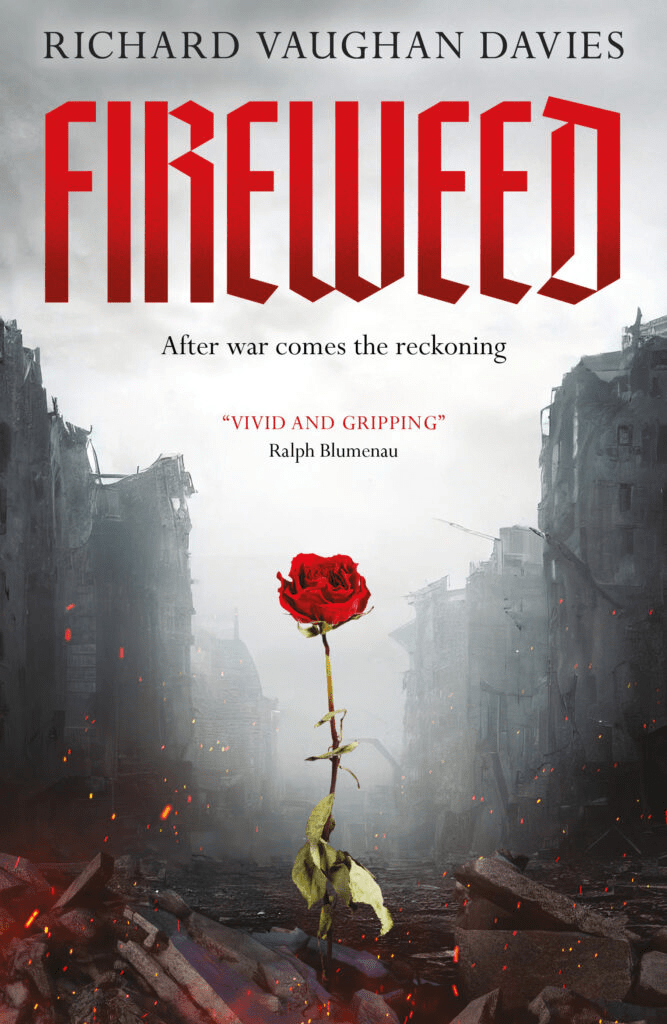
Fireweed by Richard Vaughan Davies: A Review

inkspot publishing

(inkspotpublishing.com).

‘In parts of the city, the whole street system has disappeared. People who have lived here all their lives can no longer find their bearings. Huge piles of rubble, concrete and collapsed or derelict buildings are the new landmarks to be negotiated, where once stood houses and shops inhabited by industrious housewives and tired clerks, noisy children and grumbling grandparents. Winding cobbled lanes, with black and white half-timbered medieval houses which survived the Plague and the Black Death, have vanished forever. The delicately wrought stained glass windows, soaring roofs, and finely sculpted arches of ancient churches are now just piles of stones and blackened beams.’

It is the psychogeography of a derelict and broken Hamburg that represents the heart of this accomplished novel by Richard Vaughan Davies. The Second World War has left Hamburg shattered, a place of danger and despair, as the remaining residents attempt to navigate a city in suppressed turmoil, whilst they wrestle with the inevitable anger and guilt concerning Germany’s role as the defeated aggressor.

Vaughan Davies skilfully deploys four main characters as a means of exploring this landscape and the way that it in turn shapes its inhabitants. The novel’s main protagonist Adam, a young British military lawyer, is part of a legal team tasked with the prosecution of Nazi war criminals. Adam is a necessarily problematic ‘hero’. Falling for Rose, a German prostitute, he fantasises about a life together whilst still exploiting the woman – and other women working in the same brothel. He is naive, but it is telling that as much as the defeat of Germany has left the previously wealthy and privileged Rose destitute, so Adam’s own actions place Rose in danger. As Rose rebuilds her life on her own terms, a future life with Adam becomes increasingly precluded; a clear signal that it is only in her own agency that Rose can trust.

Rose – Rosa von Schirm und Loewen – is the embodiment of the novel’s title Fireweed, a flower that is both beautiful and resilient, stubbornly emerging from the ruins of Hamburg. The manner in which she seeks to prevail suggests a future that is both free of the past and not dependent upon the good offices of those men who seek to exploit her.

However, the two other main protagonists – war criminal Henryk van Reen and the terminally ill Dr Ernst Mann – offer differing responses to the guilt associated with Germany’s actions before and during the Second World War. Van Reen is unrepentant, casually offering an ‘only-following-orders’ defence. Mann is tormented by guilt and the weight of history. Mann is troubled by a personal connection with Hitler, the only part of the novel that I felt was somewhat unconvincing and unnecessary. The much more resonant guilt that becomes apparent as we learn more about Mann’s role during the war should have been foregrounded and did not need the personal association with Hitler.

Indeed, the aspect of the novel I found most compelling was its consideration of the aftermath of a major conflict and the damage inflicted on the people and places transformed by that conflict. Whilst the damage to a city can be observed and ostensibly repaired, it also acts as a reminder that war leaves a bitter legacy for its survivors, both nominal winners and losers, a legacy not so readily repaired.

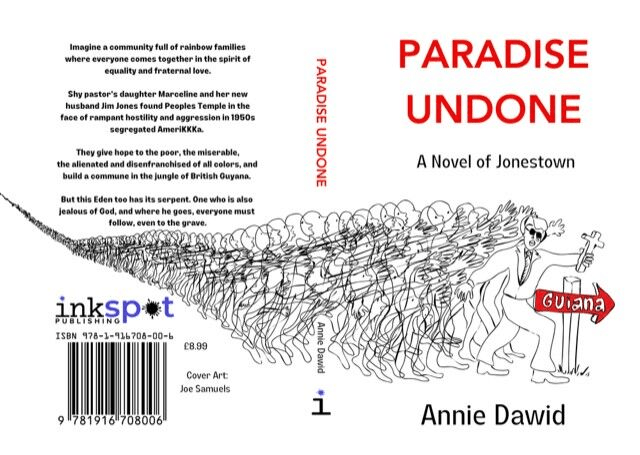
Paradise Undone by Annie Dawid: A Review

Annie Dawid (anniedawid.com)

inkspot publishing (inkspotpublishing.com)

‘I’ll never forget that smell. Almonds. Almonds everywhere. You’d think it would stink. After everyone was dead, it did. But when the people were lining up and the doc and the nurses were getting everything ready with their little colored syringes and paper cups and all, it smelled good. Sweet. Didn’t smell like death. Like what the army guys started calling “Jonestown perfume” later on.’

The Peoples Temple Agricultural Project, more commonly known by its informal name ‘Jonestown’, was a remote settlement in the South American country Guyana, established by the Peoples Temple, an American cult movement under the leadership of Jim Jones. Jonestown became infamous globally when, on Saturday 18th November 1978, a total of 918 people were murdered or committed suicide at the settlement, at the nearby airstrip in Port Kaituma, and at a Temple-run building in Georgetown, Guyana’s capital city. Since that date, the name of the settlement has become synonymous with the horrific incidents that took place at those locations.

In honour of those fatalities, and in commemoration of those human beings who worked towards a Utopian ideal of a just society for all, Annie Dawid has written a moving and potent re-telling of those events, combining real and fictious actors in the Jonestown tragedy. Dawid privileges the perspective of four main protagonists, using their voices to convey a rounded and nuanced depiction of events. The novel opens with Watts Freeman, one of the few Jonestown escapees, interviewed by a public radio host about his experiences some decades after the massacre. We hear from Truth Miller, a white woman who cannot let go of her emotional commitment to Jim Jones and the Peoples Temple. A different perspective is provided by Virgil Nascimento, a fictional character based upon on Laurence Mann, the Guyanese ambassador to the United States. The most significant voice is that of the fictionalised Marceline, the emotionally abused wife of Jim Jones. It is Marceline’s account that gives us the backstory to Jim Jones’s rise as a cult leader and the development of the Peoples Temple. Crucially, it is Marceline’s perspective of an unfaithful and abusive Jim Jones that lays bare the hypocrisy and corruption at the heart of the Peoples Temple. As Marceline is trapped in a loveless and destructive marriage, so the members of the cult are enthralled and captured by Jones’s charismatic leadership.

Dawid uses the Truth Miller character to comment on the insidious and enduring nature of populist cults and their malign influence. Many years after the tragedy, Miller remains in the thrall of the late Jim Jones, viewing those who left the Temple as ‘traitors’. Despite the evidence of her own experiences, Miller refuses to break faith with Jones. In common with the late Marceline, Miller is trapped. She names here son Cuffy after the leader of an unsuccessful slave revolt in Guyana. The past is all Miller has and therefore she cannot accept that her adherence to the cult of the Peoples Temple was profoundly misguided.

Virgil Nascimento’s story demonstrates how far reaching and persuasive Jones’s narrative was. A senior member of the Guyanese establishment, Nascimento is duped into marrying Nancy, one of Jones’s acolytes. Following the tragedy, Nascimento finds that he cannot live with the knowledge that he remains in thrall to Jones through his marriage. Nascimento only finds escape in murdering his wife and child and committing suicide, the deaths an echo of the loss of the 918 lives on that day in November 1978.

Dawid skillfully conveys the gravitational weight of the mass suicides and murder by fragmenting and destabilising the narrative. The four main protagonist speak from various points of the timeline, before, during and after the massacre. Time is out of joint, with all perspectives and events dragged into commentary on that terrible day in November 1978. In effect, the past, future and present cannot escape that gravitational pull. All those touched by the tragedy remain haunted by it. The pre-massacre sections of the novel foreshadowing the mass suicides, tainted by the abortive hopes and futures of all those who lost their lives and those who survived, only to find that they remain trapped. The post-tragedy sections are indicative of the inescapable nature of such happenings. The past is inescapable. Some reviews have been critical of the abrupt way that the novel concludes. However, an abrupt and unresolved ending is entirely fitting. The massacre was obviously the most abrupt of endings, and one which denied survivors resolution.

Paradise Undone is ultimately a cautionary tale. We now live in a world dominated by charismatic populists who will stop at nothing to secure and maintain power and influence. All they need to prevail is the complicity of those they will inevitably betray. As the events of 18th November 1978 tell us, the price to be paid for that complicity is high and bitter.

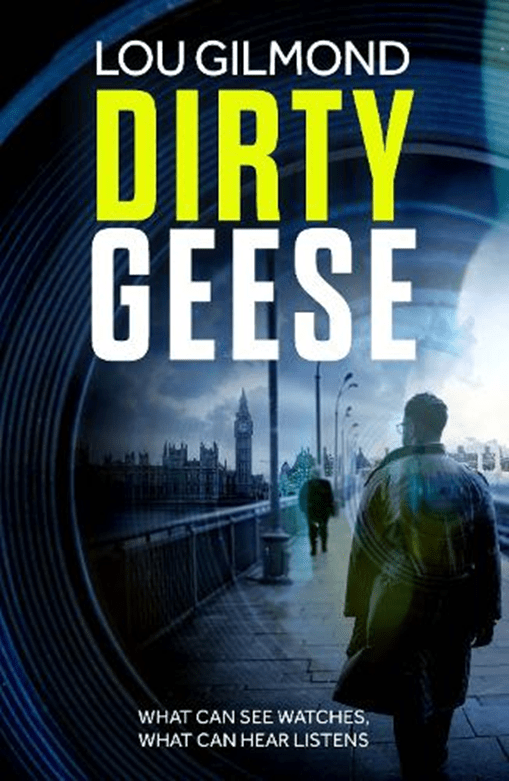
Dirty Geese by Lou Gilmond: A Review

Lou Gilmond (lougilmond.com)

Fairlight Books (fairlightbooks.co.uk)

It’s me again. Percy Dvořáček. Do you know what I think, mmm? I think we’re all just stupid geese. Greedy. Waddling around pushing our stupid fat chests out, squawking across the House at one another, as if we mattered. As if we were important, but we’re not. None of us are. We’re too far behind. And we’re all dirty, aren’t we, hmm? … So what are we, eh? Just stupid, useless, dirty fucking geese. We don’t know anything, but they’re watching us, listening to us. And they’re inside my head, I tell you. And I don’t want them there.

About his fictional private investigator, Philip Marlowe, Raymond Chandler wrote, ‘down these mean streets a man must go who is not himself mean, who is neither tarnished nor afraid. He must be, to use a rather weathered phrase, a man of honor—by instinct, by inevitability, without thought of it, and certainly without saying it.’ Lou Gilmond has given us a new man of honour, Harry Coleby. The ‘mean streets’ frequented by Harry are the corridors of power in Westminster’s Houses of Parliament, a place tarnished by greed, betrayal, mendacity, exploitation and innate corruption; a compelling if somewhat sceptical characterisation of the current state of British political life!

Following the suicide of the UK Minister for Personal Information, backbench MP Harry Coleby finds himself promoted to the Cabinet as the dead Minister’s replacement. Harry is immediately tasked with ensuring that his predecessor’s privacy bill makes it way through the parliamentary legislative process. However this will not be the first time that the proposed changes in law have been considered by the House of Commons. Shortly before his death, the previous minister appears to have tried to get the legislation passed as a private members bill, much to the consternation of the Prime Minister.

These events kick off a gripping political thriller, as Harry Coleby and Esme Kanha, the Government’s Chief Whip, are caught up in a miasma of intrigue, encountering Voter Services, a somewhat sinister organisation involved with their party’s electoral campaigning, using Alchemina, software that gets deep into voters’ minds.

This combination of recognisable political intrigue and advanced AI driven technology is remarkably effective. The rather down-at-heel qualities of life as a British parliamentarian are thrown into sharp relief by the wealth and power exhibited by those developing this technology, dependent upon access to our most private information.

In the tradition of George Orwell and John le Carré, Dirty Geese plays with a number of our key anxieties, including the loss of confidence in the British political system and the apparently relentless erosion of privacy as identities are available for trade and we are subject to what feels like 24-hour surveillance. Lou Gilmond manages the tension between these two themes well, adding into the mix personal challenges for Esme and Harry, including the toxic state of Harry’s marriage. As a consequence, Dirty Geese is both compelling and unsettling from the outset.

It’s good to know that more novels featuring Harry and Esme are planned.

The Devil’s Whispers by Lucas Hault: A Review

Thanks to TCK Publishing for sending me this book in exchange for an honest review.

Please note that this review contains spoilers.

I should have relished The Devil’s Whispers. For an ardent Gothicist this novel appears to have it all: a creepy, labyrinthine castle, a monstrous villain, devilish females, body horror, mystery, possession, and frightening jeopardy. However, like a substandard tribute band, all the novel left me with was a desire to enjoy the real thing.

The Devil’s Whispers is an attempt at a recreation of Bram Stoker’s Dracula, even down to its epistolary form. In Transylvania’s place we are presented with a Welsh castle near Cardiff. Lawyer Jonathan Harker… apologies, Gerard Woodward… has been summoned to the Castle to conduct legal business for the dying Lord Mathers. However, soon it becomes clear that all is not well and Woodward is imprisoned. On escaping his locked room he encounters the beautiful Lady Helena and her sinister doppelganger. Woodward is abused and traumatised, eventually only escaping the Castle with the help of a double-agent servant.

Meanwhile, all is not well in London. Whilst Woodward’s wife Mina… apologies Raelyn… frets about her husband, children are being kidnapped, animals mutilated, and a monstrous creature terrorises the city, much to the concern of Raelyn, her friend Lucy… apologies Jayda… and Professor Van Helsing… apologies Father Malcolm (by now I am sure you get the picture). There is even a zoophagous character riffing on Dracula‘s Renfield.

Sharing Mina Harker’s fate, Raelyn comes under the influence of the novel’s evil protagonists (the Xana) before she is saved by her friends. The Xana are nowhere near as well-developed as Stoker’s vampires although they share many of the same traits – there is an absence of rationale explaining their characteristics and their vulnerabilities.

Where The Devil’s Whispers does depart from Dracula it fails to convince. Cardiff is unrecognisable and never plausibly rendered as a stand-in for Transylvania. In an attempt to afford Raelyn Woodward more agency than Mina Harker, Hault makes Raelyn a medical doctor with her own practice. However, the remarkable nature of such an arrangement in 1903 is never addressed. The dialogue disconcertingly vacillates from turn-of-the-century to modern day idiom (‘Who the hell is Maria?’). The novel’s conclusion is rushed and perfunctory, with Raelyn and Gerard prevailing seemingly because that is what happened to their progenitors, Mina and Jonathan Harker.

All of this is not to say that the novel isn’t readable. This reader was carried along by the novel’s events. But, the bottom line is faced with a choice, read Dracula not The Devil’s Whispers. And if you have already read Dracula, read it again.

Publication: February 20th 2022
Publisher: TCK Publishing
Pages: 239 pages
Source: TCK Publishing
Genre: Fiction, Epistolary, Gothic, Horror
My Rating: ⛤⛤
Summary:

Famed British lawyer Gerard Woodward is summoned to an ancient Welsh castle to assist a dying lord in his final affairs. But as his host slips closer to death, Gerard begins to feel less like a guest and more like a prisoner. When he finds himself locked inside his room, he realizes he must escape.

After finding his way out of his room, Gerard begins to wonder if he was safer locked inside. The labyrinthine halls echo secrets. A terrible wail and the rattling of chains sets his nerves on end. Something sinister is happening within the walls of Mathers Castle, and when he descends into the dungeons, he discovers a horrible secret…

In nearby London, children vanish into the night, animals are horribly mutilated, and a savage creature stalks the shadows. When Gerard’s wife, Raelyn, becomes the creature’s next target, his need to escape reaches a fever pitch. He must get out alive so he can dispel the evil that threatens to destroy his beloved Raelyn… and the rest of us.

Things we lost in the fire by Marina Enriquez (translated by Megan McDowell) – A critical evaluation

Introduction:

Enriquez, Marina, Things we lost in the fire, trans. by Megan McDowell (London: Portobello Books, 2017).

‘These grotesque visions of bodily trauma from Argentina reflect a country still coming to terms with decades of violent dictatorship.’[1]

Summary:

 This collection of short stories, all but one told from a female perspective, reflects upon the precarious nature of lives of women and other vulnerable groups in post-dictatorship Argentina.

The collection’s central theme is bodily trauma, often self-inflicted.  In ‘End of Term’ a schoolgirl removes her fingernails with her teeth in response to ‘what the man with slicked-back hair made her do.’[2]  In ‘Adela’s House’ a boy jumps in front of a train and is obliterated so thoroughly that only his left arm remains between the tracks: ‘It seemed like someone had carried that arm to the middle of the tracks to display it like a greeting or a message.’[3] In the collection’s title story, ‘Things we lost in the fire’, women begin to set fire to themselves in response to male violence.

Analysis:

Mariana Enriquez has commented that ‘the dictatorship in Argentina was incredibly violent but in a very secret way. Thousands were tortured and killed, yes, but this was very successfully hidden from the population.’[4]  It is this combination of violence and secrecy that makes the Gothic the natural literary genre with which to engage with the precarity of the lives of Argentina’s most vulnerable citizens, a precarity that has been caused by an oppressive and abusive political regime.

Most of the stories turn on the familiar made unfamiliar, directly evoking Freud’s concept of the ‘uncanny’.  As Ona Russell notes ‘all is normal, relatively speaking, until X occurs.’[5]  Thus the reader is unsettled by a dirty handshake, a girl pulling off her fingernails with her teeth, and an amputee coddles her stump.  In addition, moments of personal epiphany are punctuated with supernatural incidents. The terrors conveyed are therefore both real and metaphorical.

Again evoking Freud’s reflections on the uncanny, Enriquez’s stories accentuate the importance of place.  In particular houses and homes are made prisons rather than havens, in Freud’s terms the heimlichis made unheimlich.

Thus Enriquez is unequivocally using Gothic devices to reflect on the precarity of life for many still affected by widespread political violence of Argentina’s recent past, a past which Enriquez has said ‘leaves scars, like a national PTSD.’[6]  This evokes Judith Butler’s proposition that ‘injurability and aggression [represent] two points of departure for political life’[7]as she engages with Emmanuel Levinas’s ‘conception of the precariousness of life, one that begins with the precarious life of the Other.’[8]For Enriquez the repression of Argentina’s dictatorship past remains, haunting the present day in the enduring damage done to the most vulnerable in Argentinian society.  It is in response to this that ‘the stories in Things We Lost in the Fireshine a light on those scars.  Haunted houses, deformed bodies, polluted rivers, all point to the “horrifying history of state terror”, to quote [Enriquez’s] English translator, Megan McDowell.’[9]

Notwithstanding the collection’s undoubted power, the stories’ relentless grotesquerie runs the risk of numbing the reader to the plight of those whose precarity of life is exposed.  This highlights a central question regarding Gothic fiction’s capacity to offer a means with which to engage with the plight of those othered by systemic injury and aggression.  Whilst Gothic fiction’s delight in the transgressive ensures that it is the natural genre for telling these stories, its ambivalent response to oppressive authority arguably compromises its capacity to convey the much-needed counter narratives of those whose lives have been made precarious by such oppression.


[1]John Self, ‘Things we lost in the fireby Mariana Enríquez review – gruesome short stories’, The Guardian [online] (2 November 2018) https://www.theguardian.com/books/2018/nov/02/things-we-lost-in-the-fire-by-mariana-enriquez-review[accessed 12 March 2019] (para 1 of 4)

[2]Mariana Enriquez, Things we lost in the fire, trans. by Megan McDowell (London: Portobello Books, 2017), p. 124.

[3]Enriquez, p. 69.

[4]Bongani Kona, ‘”Dark history is good for literature”—Bongani Kona chats to Argentine author Mariana Enriquez about her English debut, Things We Lost in the Fire’, The Johannesburg Review of Books[online] (2 July 2018) https://johannesburgreviewofbooks.com/2018/07/02/dark-history-is-good-for-literature-bongani-kona-chats-to-argentine-author-mariana-enriquez-about-her-english-debut-things-we-lost-in-the-fire/[accessed on 12 March 2019] (para 5 of 25).

[5]Ona Russell, ‘Things We Lost in the Fire’,Americas Quarterly[online] (Young Entrepreneurs Issue, 2017) https://www.americasquarterly.org/content/things-we-lost-fire[accessed on 13 March 2019] (para 2 of 6).

[6]Kona, (para 6 of 25).

[7]Judith Butler, Precarious Life: The Powers of Mourning and Violence(London & New York: Verso, 2006), p. xii

[8]Butler, pp. xvii-xviii.

[9]Kona, (para 6 0f 25).

The Frighteners by Peter Laws: A review.

‘[T]his channelling of dark desires is a skill we humans have been trying to perfect for millennia.’

Peter Laws makes a compelling case for the societal good that comes from literature and art of terror and horror. Rather than seeing such works as deviant or corrupting Laws deftly argues that they play an important role in affording us a safe way of dealing with our darkest fears, experiences and desires.

This is an engaging and highly readable discussion of this important subject. At times Laws’ personable and colloquial approach belies the fundamental importance of his argument, but nevertheless he comprehensively covers the main aspects of the art of horror and deploys a sound evidence based methodology.

Never give up…

As a child I read. I read and read. In fact my memory does not extend far enough back to remember a time when I couldn’t read.

In my early years I read Enid Blyton, from the Magic Faraway Tree and the Wishing Chair to the Famous Five and the Five Finder-Outers.  I read those books over and over and over again. I then graduated to the oh-so-grown-up Doctor Who target novels, giving me a chance to enjoy Doctor Who stories broadcast before I was born or from a time that I could not remember (my earliest TV memory is the moon landing – I think.  My earliest Doctor Who memory is the Sea Devils emerging from the sea – again, I think).  Again I read those novels over and over and over again.

There was a time when I stopped reading Enid Blyton.  I have never stopped reading Doctor Who novels! But in my early teens my reading exploded: Lord of the Rings, the science-fiction stories of Isaac Asimov, Stephen King’s horror novels, the Fontana Books of Great Ghost Stories (can you detect the roots of an obsession with the Gothic?).  And of course Jane Eyre.  My love affair with the Brontës began as a thirteen year-old school boy and I have never lost that particular passion.

‘O’ Level English Literature was a joy: Macbeth, Romeo and Juliet, Jane Eyre… ‘A’ Level English Literature even more so: Seamus Heaney, The Rime Of The Ancient Mariner, The Go-Between, Othello, Richard II, Songs of Innocence and Experience, Waiting for Godot, and, of course, Wuthering Heights.  I loved every one.  Sometimes some texts more in retrospect.  It took me a while to understand Heaney.  Some texts I adored immediately.  LP Hartley’s The Go-Between and Emily Brontë’s Wuthering Heights remain amongst my favourite  novels to this day.

So you can picture the scene as I turned up for my meeting with my tertiary college’s career advisor to discuss my choice of university subjects.  What choice? It was obvious.  I was going to read English.  It turns out this was a poor choice!  Apparently I would stand more chance of redeeming Heathcliff than getting a job with a degree in English. Crestfallen I applied to Durham University to read History and Politics (much more career friendly) and spent three, admittedly happy years, choosing modules that would get me as close to literature as possible, immersing myself in student politics, and graduating with a disappointing 2:II.

In the end it was my student political activities that secured me a place on the NHS graduate scheme.  My choice of degree subject was irrelevant.  Who knew? Certainly not my careers advisor.  There began a tumultuous but rewarding career in senior management in the NHS and healthcare more broadly.

Of course I continued to read avidly.  Crime fiction, literary fiction, science fiction, fantasy.  It has never left me.  The desire to visit other times and places simply through the power of the written word.  To enjoy the power of language alone.

And yet I remained disconcerted.  I had an abiding sense of ‘unfinished business.’ I knew I had it in me to excel academically and I was consumed by a desire to return to the formal study of English.

Therefore on being made redundant in 2011 the opportunity presented itself.  Could I take a part-time Open University degree in English Literature and work freelance part-time?  Well, the second ‘part-time’ never materialised.  I worked as a freelance management consultant for three and a half years but nearly always full-time plus.  But I did take an OU degree in English Literature, securing a First in every module that counted towards the final classification.  Those modules were glorious: Reading and Studying English Literature (including Wuthering Heights!), The Nineteenth-Century Novel (my favourite, a chance to academically revisit Jane Eyre, and an opportunity to study George Eliot’s Middlemarch – the greatest novel ever written). Twentieth-Century English Literature, and Children’s Literature.  I loved every one.  It was like being given new, much more powerful spectacles.  My understanding of literature, its importance and its power grew and grew.  I will always be grateful to the Open University.

A year before I was due to complete my OU degree I decided to take another career break.  I held a senior position in NHS England. I had rejoined in 2015 but was struggling with the politics of it all so resigned without a job to go to.  I was determined to make the most of this time and, in addition to completing my OU degree, decided to take a Masters in English Studies at the University of Lincoln.  Oh, the sheer joy of it: Twenty-First century poetry, drama and novels, the Nineteenth-Century Woman Writer (Brontës again – this time the wonderful Anne!), Contemporary American Fiction and a dissertation that looked at Gothic fiction’s response to Trump’s election and presidency.  The staff and students made the year a sublime experience.  One that will stay with me always.  I finished with a Distinction.  One of the proudest achievements of my life, second only to the pride and pleasure I take in my two, amazing daughters.

This journey is not over.  In fact it will now never end.  On the 7th December I was offered a part-time place on the University of Lincoln’s English Studies PhD programme.  I begin on the 6th February.

I feel so blessed.  Thanks to a supportive family and the help of so many dedicated teachers and academics I find myself with the continued chance to study a subject I love with all my heart.

The messages:

  1. Ignore careers advice.  Study the subjects you love.  Jobs will come regardless of the subject you choose;
  2. Never give up.  Never, ever give up;
  3. Always keep a place in your life for the Brontë sisters – they’ll never fail you;
  4. Oh – and good luck!


Stone Mothers by Erin Kelly: A review.

NB: This review contains some minor plot spoilers.


‘The blindfold hurts. His inexperience shows in the knot. It’s tight but crude, and has captured a hank of my hair.’[1]


Erin Kelly’s latest novel Stone Mothers, to be published in April 2019, explores incarceration in many of its forms. Consequently Kelly expertly deploys Gothic motifs, themes and devices that were present in the earliest examples of Gothic fiction.


As Alice Cresswell states;


[i]mprisonment and the feeling of isolation is a theme in many gothic texts. In [The Castle of] Otranto, the prison-like nature of the castle is an example of this. Particularly when Isabella tries to escape Manfred; she can never escape the castle and instead must trawl through its winding corridors and underbelly. The fact she cannot escape adds heavily to the suspense filled nature of the novel as we are sure she will be caught.[2]


In Stone Mothers the novel’s unsettling qualities are drawn from the characters’ own physical, mental and emotional imprisonment and feelings of isolation.


The most obvious, physical representation of incarceration is the Nazareth Hospital itself. Earlier known as The East Anglia Pauper Lunatic Asylum, readers encounter Nazareth initially as Park Royal Manor, a newly refurbished residential development in 2018, then a closed and crumbling Mental Hospital in the 1980s, and then finally as an operational mental hospital in the 1950s. Kelly’s narrative, progressing backwards chronologically, peels away the building’s layers, exposing its catastrophic impact upon the lives of those who were bound up with the fate of that institution.


The symbolic nature of Nazareth Hospital is inescapable. It represents a physical manifestation of the many ways in which we are incarcerated as a consequence of societal attitudes, physical and mental ill-health, and the secrets of a past that constantly threatens to resurface. Initial protagonists Marianne Thackeray and Jesse Brame are entrapped by the secrets of their youth, secrets that irresistibly return with the most catastrophic consequences. As Nazareth Hospital’s past is hidden by its refurbishment into Park Royal Manor, Marianne Smy’s impoverished and disadvantaged past identity is hidden by her reinvention as Dr Thackeray, art historian. However, as Nazareth’s past is always just beneath the surface, Marianne’s personal past is never far away. Her Suffolk accent is occasionally evident, a reminder that the secrets of her past are always with her.


Similarly Baroness Helen Greenlaw’s past continues to hold power over her. Her own incarceration in Nazareth in the 1950s as a pregnant, unmarried teenager evokes the imprisonment and isolation that befalls those who lack influence in any given society and at the same time fall foul of contemporary societal norms. The only means of escape available to Helen is to swap the abusive constraints of Nazareth Hospital with the alternative incarceration of marriage to man she doesn’t love or respect.


In many ways all of the novel’s characters are imprisoned and isolated. In the present day Debbie, Marianne’s mother is isolated and incarcerated by her worsening dementia. Jesse Brame is a prisoner of both his disadvantaged background and his obsession with the past. Marianne’s daughter, Honor, is threatened by her mother’s secrets and is constrained by her own mental ill-health.


It is this consistent and powerful engagement with these themes that ensures that Stone Mothers offers both a compelling narrative and an intelligent, coherent use of Gothic devices in order to address the durability of those societal forces that would incarcerate us all.


[1] Erin Kelly, Stone Mothers (London: Hodder & Stroughton, 2019), p. 3.

[2] Alice Cresswell, ‘Gothic Literary Devices’, The Castle of Otranto website edited by Alice Cresswell. Available at https://castleofotranto.wordpress.com/contextual-mini-essays/gothic-literary-devices/ [accessed 15 December 2018], para 3 of 5.